
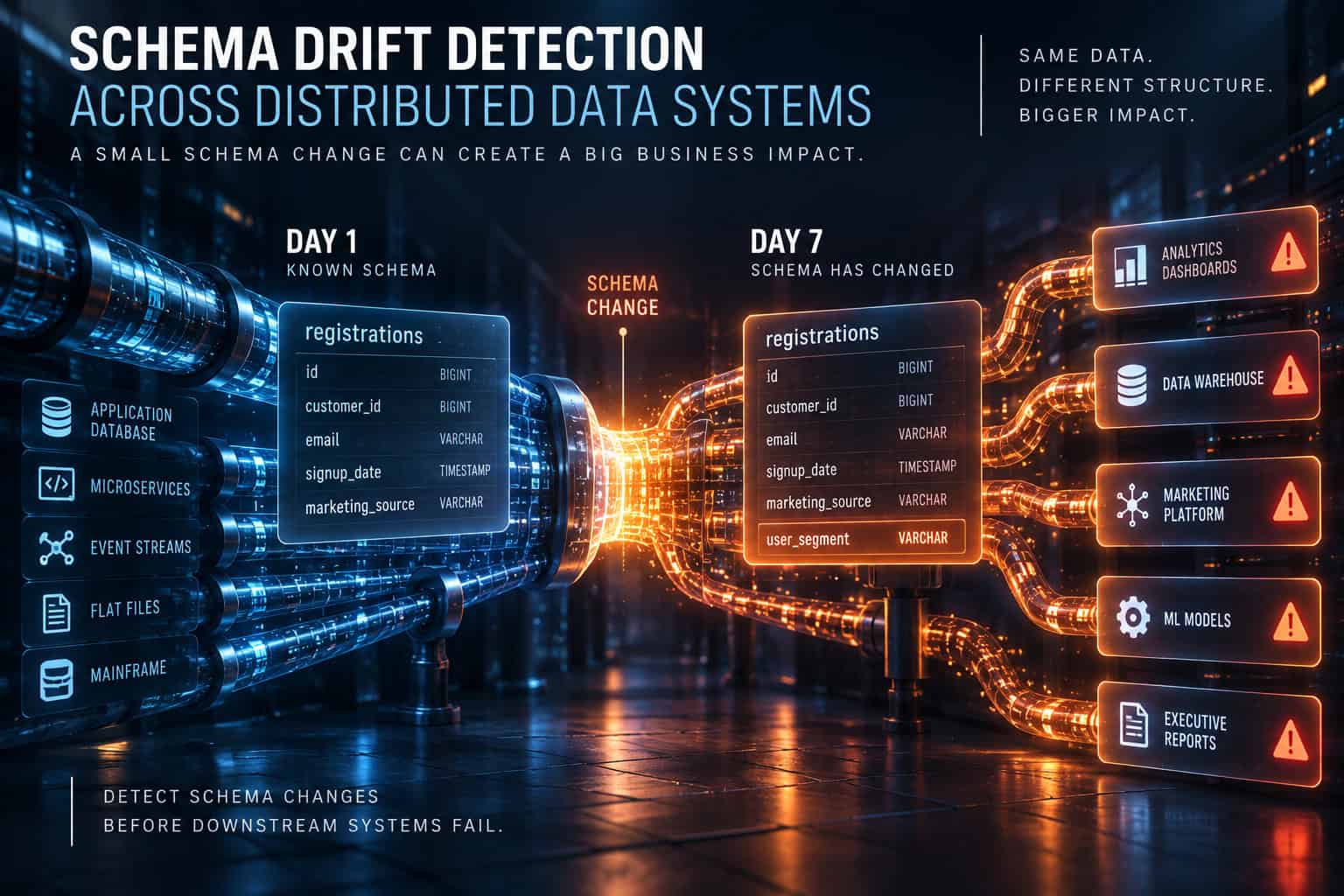
The analytics dashboard was correct on Tuesday. By Thursday it showed a 23 percent drop in customer acquisition that the business team was treating as a genuine business signal, reorganizing marketing budgets, pausing campaigns, escalating to the board. The data engineering team discovered on Friday that the upstream service had added a nullable column to the registrations table six days earlier. The ETL pipeline had not been updated. The calculation that derived the acquisition metric was treating the new nulls as zeros rather than excluding them. No schema change notification had been sent. No contract had been broken in a way that produced an error. The pipeline ran successfully; it produced wrong numbers that looked right.
Schema drift represents a structural mutation, unlike data quality issues where values are incorrect, schema drift breaks the contract between source and destination. In a monolithic database environment with a central DBA who controls all DDL, that contract is enforced by a single authority. In a distributed system, where dozens of independent services each own their own data store, where event streams carry Avro schemas that evolve independently, where flat file interfaces between mainframe batch jobs and cloud analytics platforms define implicit contracts that exist in neither system’s documentation, the contract is distributed across every boundary in the system. Schema drift in a distributed environment does not wait for a DBA to make a mistake. It emerges from the normal operation of autonomous teams making individually sensible decisions without complete visibility into every downstream consumer of their data.
Map the Legacy Schema Boundary
SMART TS XL identifies every flat file format contract connecting mainframe programs to modern analytics platforms.
DESCUBRE MÁS…What Schema Drift Is, and What It Is Not
Schema drift is a change in the structure of a data artifact that is not reflected in the consumers of that artifact. The emphasis on consumers is what distinguishes drift from planned migration: a column rename executed simultaneously in the source table and every consuming query is a schema migration. The same rename executed only in the source table, leaving consumers reading stale column names, is schema drift.
Data pipelines rely on a contract of trust between the source system and the destination warehouse. This contract is the schema: the agreed-upon structure, data types, and column names that define the dataset. When upstream teams change their application database without notifying the data team, they break this contract.
Schema drift is not the same as data drift. Data drift is a change in the statistical distribution of values within a stable schema, average order values declining, null rates increasing, categorical distributions shifting. Both are important data quality signals, but they require different detection approaches and indicate different root causes. A schema change detection system that monitors column names and types will not catch data drift; a distribution monitoring system will not catch column additions and removals.
Schema drift is also not always harmful. Tracking drift severity over time helps distinguish between active development cycles (benign drift) and instability (critical drift). A backward-compatible addition of a nullable column to a table is schema drift, the schema changed, but it may not break any consumer that ignores the new column. The classification of drift as benign or critical requires understanding the downstream consumers and how they handle the change.
The Four Types of Schema Drift
Distributed data systems produce schema drift along four distinct dimensions, each requiring different detection mechanisms:
Type 1: Structural drift
Changes to the physical schema definition: column additions, column removals, column renames, data type changes, constraint additions or removals, table additions and removals. This is the most visible form of schema drift and the one most commonly addressed by observability tooling. Database INFORMATION_SCHEMA queries, schema registry comparisons, and migration tool audit logs capture structural drift effectively for connected systems.
Detección: Schema snapshot comparison against a baseline; INFORMATION_SCHEMA polling; schema registry version comparison.
Type 2: Semantic drift
Changes to the meaning of an existing field without changes to its definition. A column named
statusthat previously contained valuesACTIVE,INACTIVE,PENDINGnow contains values1,2,3because the producing service changed its enumeration. The schema, column name, data type, nullable constraint, is unchanged. The semantic contract is broken. Consumers that parsed string status values now receive integers that their logic does not handle.Semantic drift and context drift are newer to the conversation and dramatically less monitored, even though both are responsible for a growing share of AI program failures. Semantic drift is the hardest to catch automatically because it produces no structural signal, it requires either value distribution monitoring (the ratio of known values to unknown values changes) or explicit contract testing.
Detección: Value distribution monitoring; allowed-values validation rules; contract tests that assert specific valid values.
Type 3: Format drift
Changes to the encoding or format of values within structurally unchanged fields. A timestamp field that previously contained UTC ISO 8601 strings now contains Unix epoch integers. A currency field that previously contained decimal amounts now contains amounts in cents as integers. The column exists, the type is still valid for the new values, but the parsing convention has changed.
Format drift is particularly common at the boundaries of distributed systems, where one service serializes data in a format that another deserializes, and at the legacy-to-modern boundary, where COBOL programs write flat files with specific byte-position conventions that downstream ETL processes depend on.
Detección: Statistical profiling of value ranges and patterns; format validation rules on specific fields; boundary contract tests.
Type 4: Contract drift
Changes in the availability, freshness, or volume guarantees of a data source. The source system previously delivered a dataset by 3 AM UTC daily; it now delivers by 6 AM, silently breaking downstream processes that assumed 3 AM freshness. The source system previously guaranteed a minimum of 1,000 records per day; low-traffic periods now produce fewer. Neither change is a schema change in the structural sense, but both break the contract between producer and consumer.
Detección: Freshness monitoring; volume anomaly detection; SLA-based alerting.
Why Distributed Systems Amplify the Problem
In a monolithic system with a single database and a single application team, schema changes are controlled events. The DBA writes the migration, the developer updates the queries, the change is deployed together. The risk of schema drift exists but is bounded by the scope of the single authority.
Distributed systems remove that single authority. Each service owns its data. Each team makes schema decisions independently. The consumers of each service’s data are often outside that team’s immediate awareness, especially when the consumer is a data platform, an analytics pipeline, or a legacy integration point that no product team actively maintains.
Distributed Schema Drift Propagation Path:

Order Service          Kafka Topic           Analytics Pipeline
┌─────────────────┐   ┌───────────────┐    ┌──────────────────────┐
│ orders table    │──>│ order.created │───>│ orders_fact table    │
│ + coupon_id     │   │ Avro schema   │    │ (missing coupon_id)  │
│   (new column)  │   │ v1 still used │    │ pipeline runs fine   │
│                 │   │               │    │ coupon data silently  │
│                 │   │               │    │ dropped              │
└─────────────────┘   └───────────────┘    └──────────────────────┘

                           ▼
                   BI Dashboard
                ┌──────────────────┐
                │ coupon_revenue   │
                │ always = $0      │
                │ (no error shown) │
                └──────────────────┘
The diagram illustrates the propagation pattern: the Order Service team adds coupon_id to their database. If they also update the Kafka event schema to include coupon_id, the analytics pipeline must be updated to consume it. If the Kafka schema is still on version 1, the field never reaches the pipeline. If the pipeline is updated but the BI dashboard model is not refreshed, the field exists in the warehouse but is absent from the report. The drift can introduce a silent data loss at any of four boundaries, and each boundary requires a different detection mechanism.
Silent pipeline failures, stale dashboards, schema drift, and incomplete datasets have become major operational risks in modern enterprise data environments. Modern data stacks fail faster than traditional environments, with broken transformations, freshness failures, and silent data corruption propagating across pipelines long before teams detect issues manually.
The “silent” property is what makes distributed schema drift expensive. An error that produces an exception is noticed and fixed. A change that produces silently wrong numbers runs undetected until a business decision based on those numbers produces a visible consequence.
Detection Approaches by Layer
Schema drift detection requires different tools and techniques for each layer of a distributed system:
Database and Warehouse Layer
The most mature detection layer. INFORMATION_SCHEMA tables in every major database and warehouse provide a queryable metadata snapshot:
sql
-- Detect structural schema changes since a baseline snapshot
-- Run daily; alert when new differences appear

WITH current_schema AS (
    SELECT
        table_name,
        column_name,
        data_type,
        is_nullable,
        column_default,
        ordinal_position
    FROM information_schema.columns
    WHERE table_schema = 'production'
),
baseline AS (
    -- Previous snapshot stored in schema_baseline table
    SELECT * FROM schema_monitoring.schema_baseline
    WHERE snapshot_date = CURRENT_DATE - 1
)
SELECT
    'ADDED'   AS change_type,
    c.table_name,
    c.column_name,
    c.data_type,
    CURRENT_DATE AS detected_date
FROM current_schema c
LEFT JOIN baseline b
    ON c.table_name = b.table_name
    AND c.column_name = b.column_name
WHERE b.column_name IS NULL

UNION ALL

SELECT
    'REMOVED' AS change_type,
    b.table_name,
    b.column_name,
    b.data_type,
    CURRENT_DATE
FROM baseline b
LEFT JOIN current_schema c
    ON b.table_name = c.table_name
    AND b.column_name = c.column_name
WHERE c.column_name IS NULL

UNION ALL

SELECT
    'TYPE_CHANGED' AS change_type,
    c.table_name,
    c.column_name,
    c.data_type || ' (was: ' || b.data_type || ')' AS data_type,
    CURRENT_DATE
FROM current_schema c
JOIN baseline b
    ON c.table_name = b.table_name
    AND c.column_name = b.column_name
WHERE c.data_type <> b.data_type;
Tools that automate this pattern: dbt schema tests, Great Expectations column expectations, Monte Carlo table health monitoring, Acceldata schema drift monitoring.
Event Streaming Layer
Kafka topics use schema registries (Confluent Schema Registry, AWS Glue Schema Registry, Apicurio) to govern Avro, Protobuf, and JSON Schema evolution. The registry enforces compatibility rules at publish time:
yaml
# Confluent Schema Registry: compatibility rule configuration
# Applied per topic; enforces at producer registration time

compatibility:
  BACKWARD:
    # New schema can read data written with old schema
    # Safe: consumers can be updated after producers
    allows: add_optional_fields, remove_fields_with_defaults
    blocks: rename_fields, change_types, add_required_fields

  FORWARD:
    # Old schema can read data written with new schema
    # Safe: consumers can be deployed before producers
    allows: add_required_fields, rename_with_aliases
    blocks: remove_fields_used_by_consumers

  FULL:
    # Both backward and forward compatible
    # Strictest: ensures zero-downtime evolution
    allows: add_optional_fields_with_defaults
    blocks: everything_else
The schema registry does not prevent semantic drift, a field whose name and type are unchanged but whose meaning has changed passes compatibility checks. Contract testing (Pact, AsyncAPI testing) is required for semantic validation.
Capa API
There are four fundamentally different approaches to catching API schema drift: Spec-to-spec diffing, spec-to-reality monitoring, reality-to-reality monitoring, and traffic-based detection. Most confusion in this space comes from people comparing tools across different approaches.
For internal service APIs in a microservices architecture, consumer-driven contract testing (Pact) is the most reliable approach: each consumer specifies the contract it requires from the producer, the contracts are verified against the producer’s implementation in CI, and any change that breaks a consumer’s contract fails the producer’s test suite before deployment.
The Legacy System Boundary: Where Drift Becomes Invisible
Every detection approach described above works for systems that expose schema metadata through queryable interfaces: INFORMATION_SCHEMA, schema registries, OpenAPI specifications. At the boundary between legacy mainframe systems and modern data platforms, these interfaces do not exist.
A COBOL program that produces a nightly flat file for consumption by a cloud ETL pipeline defines an implicit schema in its FD entry and output logic. The “schema” of the flat file, the byte positions, data types, COMP-3 packed decimal fields, and REDEFINES structures, exists in the COBOL source code, not in any registry or metadata store that modern observability tools can query.
cobol
      *> This FD entry IS the schema contract for the nightly extract
      *> Any change here constitutes schema drift for the downstream ETL
       FD  CUSTOMER-EXTRACT-FILE
           LABEL RECORDS ARE STANDARD
           RECORD CONTAINS 350 CHARACTERS.
       01  CUSTOMER-EXTRACT-REC.
           05  CUST-ID          PIC 9(10).        *> Bytes 1-10
           05  CUST-NAME        PIC X(40).        *> Bytes 11-50
           05  CUST-BALANCE     PIC S9(11)V99 COMP-3. *> Bytes 51-57 (packed)
           05  CUST-STATUS-CD   PIC X(2).         *> Bytes 58-59
           05  CUST-OPEN-DATE   PIC 9(8).         *> Bytes 60-67: YYYYMMDD
           05  FILLER           PIC X(283).       *> Bytes 68-350
If the COBOL team changes CUST-BALANCE desde PIC S9(11)V99 COMP-3 a PIC S9(13)V99 COMP-3, adding two digits of precision to handle larger balance values, the field expands from 7 bytes to 8 bytes in packed decimal format. Every field after byte 50 shifts one position. The flat file the ETL pipeline reads now has all fields after CUST-BALANCE at the wrong byte positions. The ETL pipeline does not produce an error; it reads bytes 51-57 as CUST-BALANCE and interprets the next byte (which is now the first byte of CUST-BALANCE’s expanded representation) as part of CUST-STATUS-CD. The pipeline runs. The numbers are wrong. No schema drift alert fires.
This is the most dangerous class of schema drift in enterprise environments: structural changes in legacy systems that propagate silently through flat file interfaces with no detection mechanism at either end.
Three properties make legacy boundary drift uniquely dangerous:
The schema is invisible to observability tools. Monte Carlo cannot connect to a VSAM file. Acceldata cannot query an FD entry. The only way to detect the change is to compare the COBOL source against a previous version, a code analysis operation, not a data monitoring operation.
The propagation is silent. Flat file interfaces do not validate record structure; they read bytes. A change to the byte layout produces wrong values, not errors.
The blast radius is wide. A COBOL copybook included by 300 programs is a schema shared by 300 programs. A change to the copybook, the equivalent of a DDL ALTER TABLE, affects all 300 simultaneously, and every downstream consumer of any dataset produced by any of those 300 programs inherits the drift.
Schema Contracts: Formalizing What Is Usually Implicit
The structural solution to schema drift is making implicit contracts explicit, defining what the schema is, who depends on it, and what changes are permitted, before a change is made rather than after it breaks something.
| Contract Layer | Lo que rige | Accesorios | Legacy Equivalent |
|---|---|---|---|
| Database DDL | Table structure, column types, constraints | Liquibase, Flyway, Atlas | DB2 DDL migration scripts |
| Esquema de evento | Kafka/event stream structure | Confluent Schema Registry, Apicurio | N/A (flat file has no registry) |
| API contract | REST/gRPC interface expectations | OpenAPI, Pact, AsyncAPI | N/A (file interface has no spec) |
| Calidad de datos | Value distributions, freshness, volume | Great Expectations, dbt tests | N/A (no native test framework) |
| File format contract | Flat file byte layout, field positions | COBOL FD entry (source of truth) | Copybook version control |
The “Copybook version control” entry in the legacy equivalent column is the practical mechanism for managing COBOL schema evolution: treating the copybook as a versioned artifact with a change approval process, maintaining a registry of which programs include each copybook, and requiring impact analysis before any copybook modification is approved.
A copybook change approval workflow:
- Developer proposes a change to
CUSTMSTR.CPY - Impact analysis identifies every program that includes
CUSTMSTR.CPY(static analysis) - Every flat file produced by those programs is identified as a schema change event
- Every downstream consumer of those flat files is notified
- Consumer validation tests are run against the new layout
- The change is approved only when all consumers confirm compatibility
This workflow mirrors the schema registry compatibility enforcement pattern, applied to the COBOL layer where no native schema registry exists.
Monitoring Architecture for Distributed Schema Drift
A complete schema drift monitoring architecture covers all four drift types across all system layers:
Schema snapshot database. Store a daily snapshot of every table’s INFORMATION_SCHEMA metadata, every registered event schema version, every API specification version, and (for legacy systems) every copybook version. The snapshot database is the baseline against which current state is compared.
Change detection pipeline. Daily comparison jobs run against the snapshot database, detecting additions, removals, type changes, and constraint changes at every monitored layer. High-severity changes, non-backward-compatible type changes, column removals, required field additions, trigger immediate alerts. Low-severity changes, nullable column additions, index changes, generate advisory notifications.
Consumer impact registry. A catalog that maps every schema artifact to its known consumers: which pipelines read from which tables, which services consume which Kafka topics, which ETL jobs process which flat files. When a schema change is detected, the consumer impact registry determines the blast radius, how many consumers are affected and which are most critical.
Contract test suite. Automated tests that verify consumer assumptions about producer schemas. Run on every deployment that touches a data-producing service. Fail the deployment if a contract that a registered consumer depends on is violated.
Legacy boundary monitoring. For mainframe systems: version-controlled copybook comparison, JCL dataset definition monitoring, and flat file format validation against the schema defined in the producing program’s FD entry. This layer requires code analysis rather than data monitoring, detecting changes in the COBOL source that constitute schema changes for downstream consumers.
Scheduled monitoring matters more than many teams assume. Acceldata’s guidance on scheduled drift analysis recommends automated comparisons against a stable baseline on a weekly or biweekly cadence, and explicitly notes that waiting for ad hoc checks after failure is insufficient. For legacy boundary monitoring specifically, the cadence should match the COBOL deployment schedule: any copybook release to production should trigger an immediate schema impact analysis rather than waiting for the next scheduled comparison.
Cómo SMART TS XL Addresses Schema Drift in Legacy Environments
SMART TS XL addresses the detection gap at the legacy system boundary, the layer where modern observability tools stop and where the most dangerous schema drift goes undetected.
El análisis de código estático capability parses every COBOL FD entry, COPY member, and SELECT clause to produce a structured representation of every schema artifact in the legacy environment. When this analysis is run against two versions of the codebase, before and after a deployment, the differences constitute the legacy schema change log: which copybooks changed, which field definitions changed, what the before and after layouts were. This is the schema snapshot comparison applied to the COBOL layer.
El mapeo de dependencias de aplicaciones provides the consumer impact registry for legacy schemas: which programs include each copybook, which programs produce which flat file datasets, which JCL jobs invoke which programs. When the schema change log identifies a modified copybook, the dependency map immediately produces the consumer list, every program that includes the copybook and every downstream flat file that those programs produce. This is the blast radius calculation that determines whether a copybook change is a low-risk internal modification or a high-risk event that affects hundreds of programs and dozens of downstream consumers.
El análisis de impacto capability converts the blast radius into a structured remediation scope: for each consumer identified by the dependency map, what changes are required to accommodate the new schema, and in what sequence should those changes be applied? For legacy-to-modern boundary consumers, ETL pipelines that read flat files produced by COBOL programs, the impact analysis identifies the specific field position changes and data type changes that the ETL pipeline’s column mapping configuration must be updated to reflect.
El búsqueda empresarial capability makes schema artifact discovery queryable: find every program that reads a field at a specific byte position (identifying consumers that will be affected by a layout change), every copybook that defines a specific field (identifying the schema artifact that must be versioned and change-controlled), every program that produces output to a specific dataset (identifying the producers whose schema changes must trigger consumer notifications). This search capability supports both the proactive schema governance workflow and the post-drift incident investigation.
Para organizaciones que gestionan modernización heredada programs that include migrating mainframe data to modern platforms, SMART TS XL’s schema analysis provides the source schema documentation that migration tools require, the complete, current FD entry definitions and copybook structures that define what the data actually is, not just what it was when the original migration specification was written.
The Contract Nobody Wrote Is Still a Contract
Schema drift in distributed systems is not a new problem. It is an old problem that distributed architecture makes harder to solve, because the authority that enforced schema contracts in monolithic systems, the central DBA, the single application team, the unified codebase, has been distributed across dozens of independent services, each making individually sensible decisions with incomplete visibility into every downstream consumer.
The solution is not to re-centralize authority over schema. It is to make the implicit contracts explicit, register them in systems that can compare current state against baseline, enforce compatibility rules at the boundaries where changes are introduced, and monitor for violations at the boundaries where changes propagate. For modern systems, the tooling for this exists and is improving rapidly. For legacy systems at the boundary with modern platforms, the tooling gap is real and consequential, the flat file format that is a schema contract for a cloud ETL pipeline is invisible to every modern observability tool unless the COBOL source that defines it is analyzed and versioned as a schema artifact.
The dashboard that showed a 23 percent drop in customer acquisition was not wrong about the data it received. It was wrong about what the data meant, because the schema that defined the data’s meaning had changed at a boundary where no contract was registered and no monitor was watching. That boundary, wherever it exists in a distributed system, legacy or modern, is where schema drift detection programs must reach.
